

English
Thermage FLX: How Does It Differ from Previous Thermage?
Thermage FLX: How Does It Differ from Previous Thermage?
2026.07.31
Thermage FLX: How Does It Differ from Previous Thermage?
Published: July 31, 2026 | Last Updated: July 31, 2026
Medical Reviewer: Dr.Yumin Lee at MeSOnBOM Clinic
Hello.
This is MeSOnBOM Clinic.
As we age and notice declining skin elasticity and deepening wrinkles in the mirror, we often find ourselves longing for the vibrant appearance of our younger days.
To restore the slowing rate of skin regeneration and make the skin firm again, interest in non-surgical procedures has been growing significantly.
Among them, the treatment receiving the most intense attention is 'Thermage FLX,' which regenerates collagen from deep within the skin.
In today's post, we will explore in detail how Thermage FLX transforms our skin, along with its underlying medical principles and benefits.
Skin Aging and Decreased Elasticity: Why Do They Occur Medically?
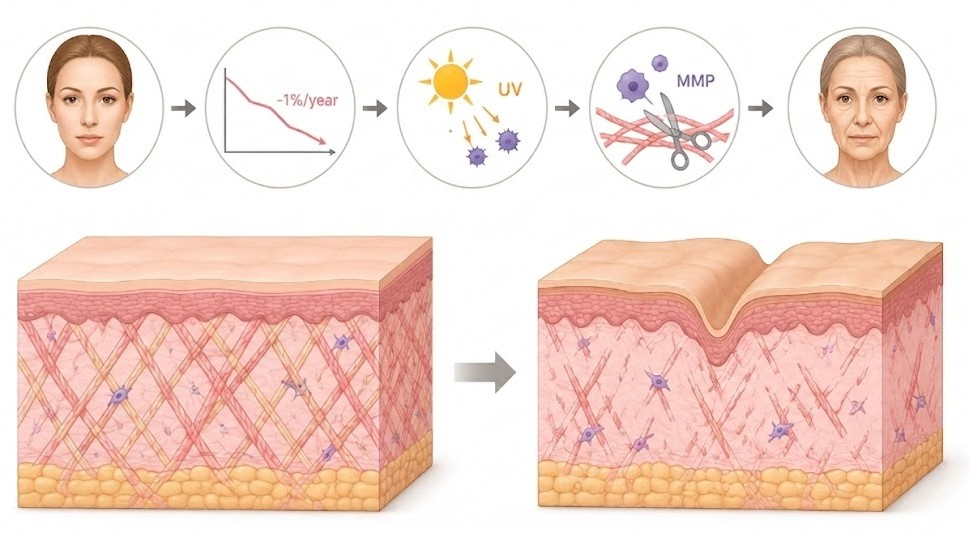
Skin aging begins in the late 20s as collagen production in the dermal layer decreases by approximately 1% each year.
Ultraviolet (UV) rays and oxidative stress destroy underlying skin structures and the dermal matrix, causing the skin to thin and lose its elasticity.
The dermal layer is primarily composed of Type I and Type III collagen and elastin fibers, which are responsible for structural support and elasticity recovery.
As people reach their late 20s, fibroblast activity in the dermis declines, reducing annual collagen synthesis.
Additionally, matrix metalloproteinases (MMPs) generated during exposure to ultraviolet (UV) radiation destroy collagen structures and damage the dermal matrix.
As a result, the epidermal layer atrophies and the stratum corneum turnover cycle is disrupted, leading to lower density and anatomical changes such as fine lines, skin sagging, enlarged pores, and blurred facial contours.
What Are the Medical Principles Behind Thermage FLX?
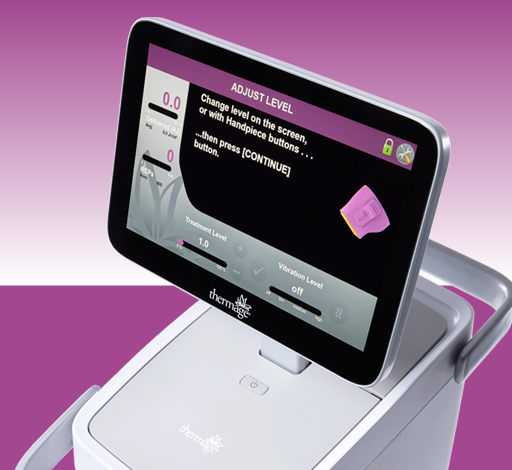
Thermage FLX is a non-invasive procedure that delivers 6.78 MHz monopolar radiofrequency (Monopolar RF) energy deep into the dermis, generating temperatures of 65–75°C to induce three-dimensional collagen denaturation and regeneration.
As radiofrequency energy generates heat through moisture stimulation in the dermal layer and subcutaneous tissue, existing aged collagen fibers immediately contract, triggering compaction and tightening of the subcutaneous tissue.
Over the following 3 to 6 months, the body's natural wound healing process is activated, stimulating fibroblasts to produce new collagen fibers (neocollagenesis).
As a result, the density of the dermal layer improves, achieving long-term elasticity restoration.
How Does the Previous Thermage CPT Differ from the Latest Thermage FLX?
The 4th-generation Thermage FLX introduces automatic adjustment algorithm (AccuREP™) technology to deliver precise energy with every shot, significantly reducing procedure time and pain.
Comparison Category | Previous Thermage (CPT) | Latest Thermage (FLX) |
|---|---|---|
Energy Measurement Technology | Measured once at the start of the procedure | AccuREP™ Algorithm (Measures skin resistance with every shot) |
Tip Area (Eye/Face standard) | 3.0 cm² | 4.0 cm² (33% increase in tip area) |
Procedure Time | Approx. 45–60 minutes | Approx. 30–40 minutes (approx. 25% reduction in procedure time) |
Pain Relief System | Horizontal vibration mode | Omnidirectional horizontal & vertical vibration & vibration cooling system |
Energy Delivery Uniformity | Potential for energy variation depending on the treatment location | Uniform energy delivery through automatic compensation for skin thickness and Ohm resistance |
What Are the Post-Procedure Precautions?

To promote the regeneration process after the procedure and prevent side effects, sufficient moisturizing, sun protection, and refraining from external heat stimuli for one week are essential.
Sun Protection: Sunscreen with SPF30/PA+++ or higher must be applied daily to prevent UV-induced skin damage while the dermal layer regenerates.
Moisturizing and Regeneration Care: Apply sufficient moisturizer and EGF-based regenerating cream to protect the barrier of heat-stimulated skin.
Avoiding Heat Stimuli: Refrain from activities that rapidly raise body temperature—such as high-temperature saunas, steam rooms, strenuous exercise, and alcohol consumption—for 7 days post-treatment.
Refraining from Exfoliation: Avoid using deep cleansers, scrubs, and chemical exfoliants (AHA/BHA) on sensitive post-procedure skin for at least one week.
Frequently Asked Questions (FAQ)
Q1. What is the onset timing of the effects and the recommended treatment interval for Thermage FLX?
Right after the procedure, you may feel immediate tightening due to heat-induced collagen contraction.
The full collagen regeneration response reaches its peak 2 to 3 months post-treatment. Although results vary depending on individual skin condition, a treatment frequency of once a year is generally recommended.
Q2. How do Ulthera (HIFU) and Thermage (RF) differ?
While Ulthera is a "lifting" procedure that creates thermal coagulation points in the deep fascia layer (SMAS) using High-Intensity Focused Ultrasound (HIFU) to pull the tissue up, Thermage is a "tightening" procedure that applies heat across the entire dermal layer using Radiofrequency (RF) to firmly tighten the skin.
Because the two procedures differ in target depth and mechanism, combining them creates a synergistic effect.
Q3. How much pain is there during the procedure?
Thermage FLX features cooling pulses and an omnidirectional vibration system, which significantly reduces pain compared to previous CPT devices.
The procedure is performed after applying topical anesthetic ointment, and medical staff precisely adjust energy levels during treatment, ensuring a safe experience without severe pain.

Author | Dr. Yumin Lee
Medical Institution | MeSOnBOM Clinic